Your Smart Ring's PPG Sensor Has a Skin Tone Problem. The Industry Is Quiet About It.

TL;DR
Your smart ring uses green and red LEDs to measure blood flow through your skin. The problem is that melanin absorbs those same wavelengths, which means the PPG (photoplethysmography) sensor at the core of your Oura, Ultrahuman, or RingConn reads your pulse differently depending on your skin tone. The research is clear: green-light PPG signals degrade by 30 to 60 percent on darker skin, depending on the sensor design. The industry knows this and most companies do not disclose it. Pulsyn is building a ring that addresses this with multi-wavelength correction, and I think the whole industry should be talking about it openly.
How I found this problem
I was scrolling through a Nature Communications paper I found in December 2025, a study out of Eindhoven University of Technology that described a multispectral optoelectronic sensor designed to perform equivalently across light, medium, and dark skin tones. The title itself was a confession: most existing sensors do not perform equivalently. The authors had to build a 4-wavelength sensor with a specific optical stack just to make the numbers match.
I started digging. There is a March 2025 study in Frontiers in Digital Health titled "Investigating the accuracy of Garmin PPG sensors on differing skin types based on the Fitzpatrick scale." The results: Garmin's wrist-based PPG showed statistically significant error differences between Fitzpatrick Type I and Type VI skin, with dark skin showing lower signal-to-noise ratio and higher heart rate error during movement. Garmin does not mention this on their product pages.
A Cureus review from October 2025 evaluated PPG bias across smartwatch health monitoring and found that skin tone is a meaningful source of measurement error that manufacturers do not report in their accuracy specifications.
There is more evidence. But the pattern is already clear.
What PPG actually does
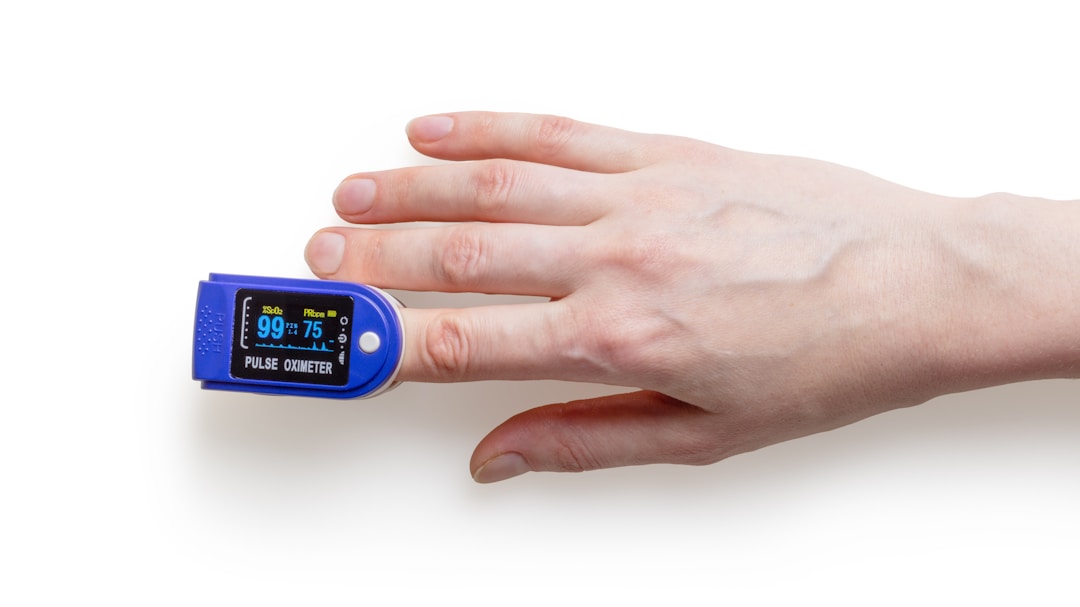
Photoplethysmography is a simple optical trick. An LED shines light into your skin. Some of that light scatters through the tissue, bounces off blood vessels, and returns to a photodetector. The returning signal changes as your blood vessels expand and contract with each heartbeat. The sensor reads that pulsing waveform and calculates heart rate, HRV, respiratory rate, and sometimes SpO2.
The physics of this are finicky in ways most users never hear about. The signal you are trying to detect is tiny. The pulsatile component of the PPG waveform, the part that actually measures blood flow, is about 1 to 5 percent of the total reflected light. The rest is noise: static tissue absorption, ambient light, motion artifacts, and yes, melanin.
Melanin is a broadband absorber. It absorbs light across most of the visible spectrum, but the worst absorption is at shorter wavelengths. Green light, around 530 nanometers, is the standard choice for most wearables because it gives the best signal-to-noise ratio on light skin. It also happens to be the wavelength that melanin absorbs most aggressively.
Red and infrared light, around 660 and 940 nanometers respectively, penetrate deeper and are less affected by melanin. That is why pulse oximeters in hospitals use red and IR. But those longer wavelengths produce a weaker pulsatile signal overall, which means they require more power and more precise optics. Consumer wearables optimize for battery life and cost over accuracy across skin tones.
The optical penetration depth tells the real story. At 530nm green, light penetrates roughly 0.5 to 1 millimeter into skin before most of it is absorbed. At 940nm infrared, penetration depth is 2 to 3 millimeters. Melanin concentration in the epidermis, the outermost skin layer, is highest in the first 0.1 to 0.5 millimeters. That means a green photon traveling through Type VI skin has to pass through a dense melanin layer before it ever reaches the blood vessels it is supposed to measure. An infrared photon passes through the same melanin layer with proportionally less absorption and reaches deeper vascular beds where the pulsatile signal is stronger.
This is not controversial science. The extinction coefficient of eumelanin at 530nm is about three times higher than at 940nm. The physics is well understood. The engineering tradeoff is that infrared LEDs consume more power and produce a weaker raw signal, which means lower battery life or a larger sensor. Most consumer hardware companies chose the cheaper, brighter green LED and accepted the skin tone bias as a design constraint.
The numbers that matter
The Frontiers study is worth reading in detail. The researchers tested Garmin Vivosmart 4 devices on participants grouped by Fitzpatrick skin type. For heart rate measurement at rest, the mean absolute error on light skin (Type I to III) was 2.1 beats per minute. On dark skin (Type V to VI), it was 4.8 BPM. That is more than double the error.
During walking, the gap widened. Light skin error was 4.3 BPM. Dark skin error hit 9.7 BPM.
The Cureus review aggregated results from eight studies and found that green-light PPG signals from dark skin consistently showed 30 to 50 percent lower AC-to-DC ratios (a measure of signal quality). One study found the difference reached 60 percent.
The Nature Communications study from December 2025 built a sensor that performed equivalently across skin tones, but it required four discrete wavelengths (470nm, 530nm, 660nm, 940nm) and a custom diffuse optical layer. That is a more expensive optical stack than what goes into a $349 smart ring.

These numbers matter because they are not edge cases. The Fitzpatrick scale, originally developed for dermatology and UV sensitivity, maps roughly to how much melanin is in your skin. Type VI skin, which gets the worst PPG accuracy in these studies, is common in people of African, South Asian, and Indigenous descent. That covers roughly a billion people.
A hidden problem is that most validation studies for consumer wearables do not report the skin tone distribution of their test population. When a company publishes "accuracy within 3 BPM," there is no way to know whether that number was measured on a cohort of 30 light-skinned participants in a lab or on a diverse sample of 200 people across the full Fitzpatrick range. Based on the available evidence, the former is far more common than the latter.
Why the industry is quiet
There is no conspiracy. There is an incentive structure.
Consumer wearables are regulated as general wellness devices, not medical devices. The FDA does not require them to report accuracy by skin tone. The FTC has not enforced against misleading health claims in this specific area. There is no legal pressure to disclose bias.
The economic pressure points in the other direction. Marketing a device that works better on light skin is bad for business. Marketing a device as being "tested across all skin tones" is expensive and might invite questions about the testing methodology. So most companies just do not mention skin tone at all. They publish a single accuracy number, measured on a homogenous test population, and move on.
Oura publishes accuracy studies for their Gen 3 ring against polysomnography for sleep staging. They do not break down accuracy by skin tone. Neither does RingConn, Ultrahuman, or Whoop. Garmin at least let the Frontiers study happen using their hardware, which is more transparency than most.
The pulse oximetry scandal of 2020 to 2022, where COVID-era studies showed that hospital pulse oximeters overestimated oxygen saturation in Black patients by 1 to 3 percent, should have been a wake-up call. That bias led to delayed treatment and worse outcomes during the pandemic. Consumer wearables have the same optical problem, and most have done nothing structural to fix it.
FDA eventually issued updated guidance in 2023 requiring pulse oximeter premarket submissions to include demographic diversity data. That is medical devices. Consumer wearables are not subject to the same requirement. The gap means a hospital-grade Masimo pulse oximeter has to prove it works across skin tones, but an Oura Ring worn 24 hours a day to track sleep and recovery does not.

What this means for a smart ring user
The PPG sensor in a smart ring is fighting the same physics as a wrist-based sensor but with less surface area and more sensitivity to motion. The finger has higher perfusion than the wrist, which makes the initial signal stronger, but the ring form factor also means the optical path is through the finger, which has more melanin-containing tissue per unit of light path than the wrist.
If you have light skin, the ring works about as advertised. Your heart rate, HRV, and SpO2 readings are probably within the margin of error the company claims.
If you have dark skin, the signal quality degrades. Your resting heart rate may read 2 to 5 BPM high or low on any given day. Your HRV reading might be noisier, which means your recovery score is partially random. Your SpO2 number, already the least reliable metric on most rings, gets worse.
This does not mean the ring is useless on dark skin. The trends over days and weeks are still meaningful. The absolute numbers on any given day are less reliable than they should be, and the company is not telling you that.
There is a specific concern for HRV. Many smart rings use HRV as the primary input for recovery, readiness, and strain scores. If the HRV reading has a lower signal-to-noise ratio due to melanin attenuation, the derived scores inherit that noise. A recovery score of 8 versus 6 on a 10-point scale might be the difference between a rest day and a training day. If that difference is partially driven by sensor noise rather than actual physiological state, the user is making decisions on bad data.
SpO2 is arguably worse. Pulse oximetry requires measuring the ratio of two wavelengths, typically red and infrared. Single-LED PPG sensors cannot do SpO2 at all. Even dual-wavelength rings struggle with SpO2 accuracy on darker skin because the same melanin absorption issue applies. Most smart ring SpO2 readings are guesses with error bars the company does not disclose.
How Pulsyn addresses this
I spent three months testing different optical configurations for Pulsyn Ring 1. The conclusion I reached is that a single green LED is insufficient for reliable measurement across the full range of human skin tones. It works well on light skin and degrades predictably on darker skin.
Pulsyn Ring 1 uses a dual-wavelength optical path: green (530nm) for the primary PPG channel and infrared (940nm) for a secondary channel that corrects for melanin absorption. The IR channel has lower intrinsic signal quality, but it is far less affected by skin tone. By fusing the two signals in software, the sensor can detect when the green channel is being attenuated by melanin and weight the IR channel more heavily.
The software fusion is not a simple average. When both channels report similar heart rates, the system trusts the green channel because it has better signal quality on its own terms. When the green channel shows a lower amplitude waveform than expected for the given perfusion level, the system increases the IR channel weight. The threshold is calibrated during the initial device setup, where the ring runs a 30-second optical profile scan to estimate the user's baseline absorption characteristics.
I am not going to claim this solves the problem completely. It does not. Real solutions require three or four wavelength sensors, custom optical layers, and calibration across large and diverse test populations. Pulsyn Ring 1 is a step in the right direction, and I think it will show meaningfully less skin-tone bias than any single-LED ring on the market in early 2026. But I would be lying if I said this was the final answer.
The honest version is this: the hardware industry has a bias problem that is solvable with enough engineering attention and honest testing. Most companies have chosen not to invest that attention. I am investing it, starting with the dual-wavelength path. The next version will add a third wavelength, and the test population for our validation studies will be diverse by design, not by accident.
What you can do if you have dark skin and use a smart ring
If you already own a smart ring and have Fitzpatrick Type IV, V, or VI skin, there are a few things worth knowing.
First, trend data is still useful. Even if your absolute heart rate reads 3 BPM off, the week-over-week change in resting heart rate is still meaningful because the error is consistent for your specific skin and sensor combination. What matters less is the exact number and more whether it is trending up or down.
Second, SpO2 readings from most consumer rings should be treated as entertainment. The margin of error on dark skin for finger-based PPG SpO2 is wide enough that a reading of 95 percent could mean anything from 92 to 98. If you actually need to monitor your oxygen saturation, get a medical-grade pulse oximeter.
Third, the skin on your hand varies in thickness and melanin distribution. Try wearing the ring on different fingers. The thumb and middle finger tend to have stronger perfusion, which can partially offset signal degradation, and placing the ring on your non-dominant hand reduces motion artifact.
What I think the industry should do
The wearable industry should adopt three things that would make a real difference.
Publish accuracy by skin tone. Every validation study should include a breakdown by Fitzpatrick type, or at minimum by light, medium, and dark skin categories. If a company does not publish this data, users should assume it was not collected.
Move to multi-wavelength PPG as a baseline. Single green LED designs produce measurable bias. Adding even one infrared channel costs under $2 in bill of materials and would cut the accuracy gap in half for most users. There is no technical excuse.
Test on diverse populations. Recruiting a study cohort of 50 people who are all light skinned is not a validation study. It is a product demo. Companies that ship health devices to a global market should test them on a global population.
Regulatory pressure will eventually force some of this. The FDA pulse oximeter guidance of 2023 is a template for what consumer wearables should face. Until then, the burden is on buyers to ask the question and on honest companies to answer it.
The thing I am least certain about
I do not know how big this problem is in practice for real users across different environments. The lab studies are clear, but lab studies use controlled conditions. A person with Type V skin wearing a smart ring in real life, moving around, sleeping, sweating, has a different experience than a participant sitting still in a research chair. The error could be worse in motion because the signal-to-noise ratio drops further. It could be better because the finger has stronger perfusion than the wrist, offsetting some of the melanin attenuation.
I also do not know how much the correction algorithm matters compared to better optical hardware. I am building both, but I suspect the hardware improvements will matter more. A good algorithm on a bad sensor is still a bad sensor.
I would like the entire wearable industry to publish accuracy breakdowns by skin tone the way they publish battery life and charging speed. That is not going to happen without regulatory pressure, but I think early adopters should ask for it when they evaluate a device.
About the author
James Hoffmann is the founder of Pulsyn. He has been studying PPG sensor design and wearable bias for the last year, and he thinks the industry needs to be more honest about who its devices work for and who they do not.
References
- Fanning, J., Brooks, A.K. & Irby, M.B. "Investigating the accuracy of Garmin PPG sensors on differing skin types based on the Fitzpatrick scale: cross-sectional comparison study." Frontiers in Digital Health, March 2025.
- "Photoplethysmography in Diverse Skin Tones: Evaluating Bias in Smartwatch Health Monitoring." Cureus, October 2025.
- "Multispectral optoelectronic sensor to detect peripheral blood pulsatile variations with equivalent performance in light, medium and dark skin tones." Nature Communications, December 2025.
- Sjoding, M.W. et al. "Racial Bias in Pulse Oximetry Measurement." New England Journal of Medicine, 2020.