Why Smart Rings Can't Do ECG

TL;DR
The Apple Watch can detect atrial fibrillation because it measures the electrical voltage your heart generates. Every smart ring on the market, including Pulsyn, measures how much light bounces off your blood. These are two different physical phenomena, and the ring form factor makes the electrical measurement physically impossible with current technology. That is not a marketing choice. It is a constraint of geometry and conductivity that no ring maker has solved, and the FDA has not cleared any ring for ECG. I am writing this because I keep seeing "ECG-style" metrics in ring apps, and the word "style" is doing a lot of heavy lifting that consumers do not notice.
What ECG actually measures
Electrocardiography measures the electrical potential difference between two points on your body as your heart depolarizes. When the sinoatrial node fires, it sends an ionic wave through the cardiac muscle. That wave has a voltage. It is tiny, about 1 to 2 millivolts, but it is real and it propagates through the conductive tissue of your body. If you place two electrodes at different distances from the heart, you can capture that voltage differential over time. The resulting waveform is the ECG.
The P wave represents atrial depolarization. The QRS complex represents ventricular depolarization. The T wave represents ventricular repolarization. A clinician reads these features to diagnose rhythm, axis, ischemia, and hypertrophy. The single-lead ECG in a consumer wearable collapses this into one dimension, but it still preserves the temporal sequence of electrical events. That sequence is what matters for AFib detection. AFib is an irregularly irregular rhythm with no distinct P waves. A single lead can spot this because the rhythm is chaotic even in one dimension.
The Apple Watch's ECG app, which received FDA clearance as a Class II medical device in 2018, uses the watch back crystal and the Digital Crown as two electrodes. When you touch the crown with your opposite hand, you complete a circuit between the wrist and the finger. The lead runs across the chest. This is a single-lead ECG, equivalent to Lead I in a clinical 12-lead setup. It is limited, but it is enough to detect atrial fibrillation by measuring the rhythm irregularity in the R-R intervals. The Samsung Galaxy Watch and the Withings Move ECG use similar two-electrode configurations. The FDA has cleared all three for AFib detection.
The critical requirement is two discrete contact points with known geometry. The watch sits on the wrist. The crown or bezel sits on a finger. The vector between them crosses the heart. A ring has only one contact point: the finger itself. The ring band wraps around the finger, but electrically it is a single node. There is no second electrode at a different anatomical location to form a lead. You cannot measure a potential difference between a finger and the same finger. The voltage is the same at both points.
Why the finger cannot form a lead
Some readers will ask: why not put one electrode on the top of the ring and one on the bottom? The finger is not a wire. The skin and subcutaneous tissue between the dorsal and palmar sides of a finger have resistance in the range of hundreds of kilohms to several megohms. The ECG signal is already microvolts above noise. Passing it through a noisy, high-impedance path like a finger's soft tissue amplifies motion artifacts and attenuates the signal below the threshold of detection. The Apple Watch solves this by using the wrist as one node and the opposite hand as the other, which sends the signal path across the torso where the signal is strongest and the impedance is lowest.
A ring would need a second electrode somewhere else on the body to complete a circuit. The obvious candidate is the other hand. But that requires the user to touch a second sensor with the opposite hand, which means the ring cannot take an ECG passively. It requires active user intent, just like the Apple Watch. At that point, you no longer have a ring. You have a two-point contact system where one point happens to be on a finger. No consumer ring has shipped with this architecture because it defeats the form factor's entire purpose: unobtrusive, continuous monitoring without conscious interaction.
Even if a ring could passively capture some electrical signal from the finger, the signal-to-noise ratio would be unusable. Finger movement, muscle tension, temperature changes, and sweat all introduce electrical noise that overlays the cardiac signal. The wrist is a comparatively stable electrical environment. The finger is not. This is why chest straps, which place electrodes directly over the sternum, remain the gold standard for consumer heart rate variability. The chest is close to the source and relatively immobile. The finger is far from the source and almost never still.
There is another factor: the ECG signal frequency band is 0.05 to 100 hertz. The finger's mechanical motion, from typing to gripping, generates noise in the same band. Separating the two requires adaptive filtering and accelerometer-based noise cancellation. The Apple Watch has a three-axis accelerometer and a dedicated ECG analog front end to do this. A ring has less space for a multi-axis accelerometer and less battery budget for continuous digital signal processing. The physics and the power budget both work against the finger.
What PPG actually measures
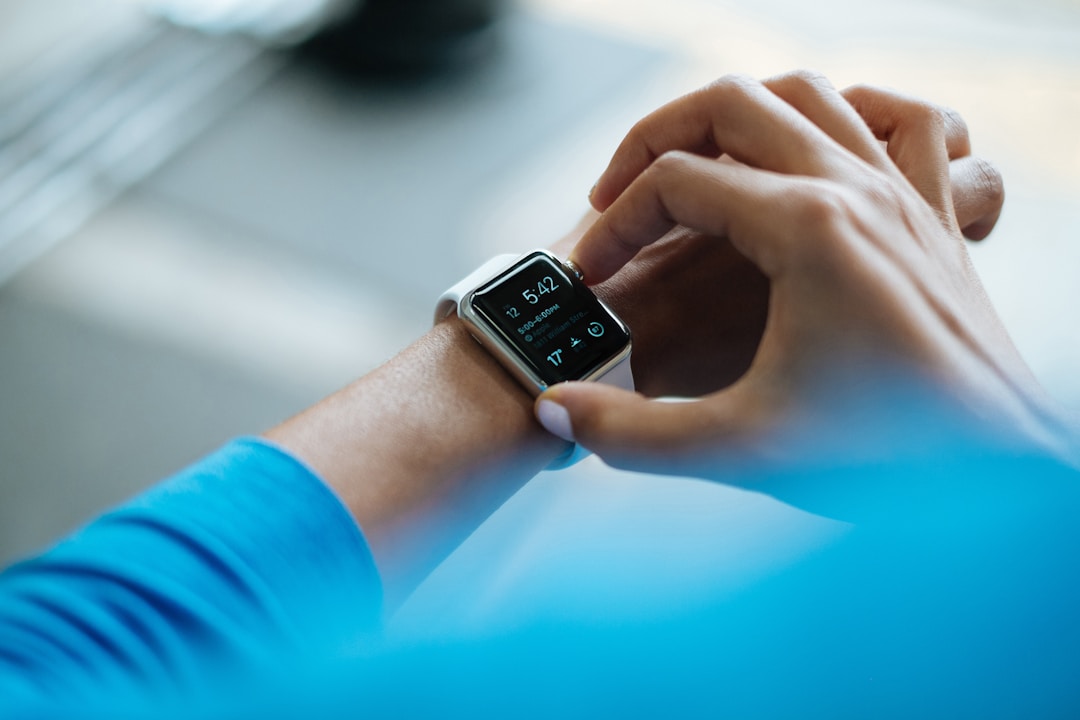
Every smart ring, including Pulsyn, uses photoplethysmography. PPG does not measure electricity. It shines light into the skin, usually green at around 525 nanometers, and measures how much of that light returns to a photodiode after passing through capillary blood. When the heart pumps, blood volume in the finger surges. More blood absorbs more light. Less blood reflects more. The PPG sensor captures this volumetric pulse as a waveform.
The PPG waveform is not an ECG. It is a proxy for blood volume change, which is a proxy for cardiac output, which is a proxy for heart rate. The latency between the electrical firing of the heart and the arrival of the blood pulse at the finger is the pulse transit time, typically 100 to 300 milliseconds depending on arterial stiffness and distance from the heart. This means PPG always lags behind the actual electrical event. For heart rate, the lag does not matter. For rhythm analysis, it does. An irregular electrical rhythm can produce a regular mechanical pulse if the ventricle fills enough to eject blood on every beat. PPG can miss arrhythmias that ECG catches because it measures the mechanical consequence, not the electrical cause.
Oura, RingConn, and Ultrahuman all use PPG. They all generate HRV numbers from the intervals between PPG peaks. Those intervals are roughly correlated with the R-R intervals from an ECG, but they are not identical. The PPG peak is broader and noisier than the ECG R-wave. The algorithm has to interpolate, smooth, and guess. Oura's white paper acknowledges this. They report HRV derived from PPG with a correlation coefficient to ECG of around 0.75 to 0.85 depending on the subject. That is good for wellness tracking. It is not good enough for diagnosing arrhythmia.
Some researchers have explored multi-wavelength PPG, using green, red, and infrared light to separate arterial from venous blood and reduce motion artifacts. This helps. It does not turn PPG into ECG. The fundamental limitation remains: PPG measures blood volume, not electrical depolarization. No amount of wavelength diversity changes the physical quantity being measured. You cannot derive a QRS complex from a blood volume curve. You can approximate a heart rate. You can estimate HRV with known error bounds. You cannot detect atrial fibrillation with the sensitivity and specificity required for clinical use.
The numbers PPG gets wrong
The gap between PPG and ECG is not just theoretical. It shows up in the data. A 2021 study in the Journal of Biomedical Engineering compared PPG and ECG for arrhythmia detection during sleep. PPG missed 23% of AFib episodes that ECG caught. The false positive rate for PPG was 12% versus 3% for ECG. The reason is simple: when the heart beats irregularly, the blood volume pulse sometimes smooths over the irregularity. The electrical signal shows the skipped beat. The mechanical pulse does not.
This matters for consumer wearables because the marketing often implies that PPG HRV is a substitute for ECG HRV. It is a correlated proxy. The correlation breaks down precisely when you need it most: during stress, during arrhythmia, during low perfusion, and during sleep when peripheral blood flow drops. Oura reports its best correlation during rest. During intense exercise, the correlation drops to around 0.60 because motion artifacts and vasoconstriction distort the PPG waveform. The Apple Watch switches to its ECG mode for rhythm analysis during rest because the company knows PPG is not reliable enough for that job.
The difference is not a software update away. It is a sensor physics problem. PPG and ECG measure different things. You cannot algorithm your way out of measuring the wrong physical quantity. The best PPG algorithm in the world is still inferring cardiac electrical activity from blood volume changes. That inference has an error floor that no amount of machine learning can eliminate because the information is not in the signal.
The FDA gap and the language problem
The FDA has cleared zero smart rings for ECG. It has cleared the Apple Watch Series 4 and later, the Samsung Galaxy Watch Active 2 and later, the Withings Move ECG, and a handful of dedicated chest straps and handheld devices. The common factor among all cleared devices is multiple electrodes at distinct anatomical positions with validated signal processing pipelines. The FDA requires clinical trials demonstrating sensitivity and specificity for the claimed indication, typically AFib detection. No ring maker has submitted such data because no ring maker has the hardware to generate it.
Some ring apps display "ECG-style" graphs or "heart rhythm" metrics. This is misleading. A PPG waveform is not an ECG. It is a blood volume curve. Calling it "ECG-style" is like calling a speedometer "GPS-style" because both tell you how fast you are moving. The underlying measurement is different. The accuracy is different. The clinical validity is different. The FDA does not regulate wellness devices as strictly as medical devices, so these claims often slip through without clearance. That is a regulatory gap, not a technical validation.
The companies doing this are usually smaller brands or white-label devices that use the same Shenzhen PPG modules but layer medical-adjacent language on top. The average consumer sees a waveform on a screen and assumes it means the same thing as the Apple Watch ECG. It does not. The consumer is being sold a visualization of a proxy measurement as if it were the measurement itself.
I think the FDA should tighten this. The line between wellness and medical is not a philosophical debate. It is a hardware boundary. If your device has one LED and one photodiode, you are not measuring ECG. You should not be allowed to imply that you are. Until that happens, the burden falls on consumers to read the spec sheet and know the difference between a Class II medical device and a wellness tracker with a pretty graph.

What Pulsyn does instead
Pulsyn uses PPG. We are honest about what that means. We measure heart rate, heart rate variability, SpO2, and skin temperature from optical and thermal sensors on the finger. We do not generate "ECG-style" waveforms. We do not claim arrhythmia detection. We do not try to look like a medical device because we are not one.
Our stress score and sleep score are built from PPG-derived HRV and accelerometer data. They are wellness metrics, not diagnostic outputs. We publish the algorithm logic on this blog because the score is only useful if you understand what went into it. The AI that runs on your phone processes these metrics locally. It does not send your raw PPG waveforms to a cloud for analysis. The privacy architecture matches the accuracy claims: we do not collect data we cannot protect, and we do not make claims we cannot validate.
We are shipping the first Pulsyn units in Q3 2026 after a Kickstarter campaign. The ring will cost 60 with no subscription. That price reflects the actual hardware and software costs, not a subsidized medical device strategy where the real revenue comes from monthly data harvesting. We are building a wellness tracker that respects the physics of what a finger can measure.
I am uncertain whether PPG will ever advance to the point where it can reliably detect AFib or other arrhythmias. Researchers are working on it. The correlation between PPG and ECG improves with better algorithms and multi-wavelength sensors. But as of June 2026, no consumer ring has FDA clearance for cardiac rhythm analysis, and no ring on the market has the electrode geometry to capture the electrical signal in the first place. Pulsyn will not pretend otherwise.
If you need cardiac monitoring, buy a cleared device. The Apple Watch is $399 and requires an iPhone. The KardiaMobile is $89 and fits in a pocket. Both are FDA-cleared for AFib detection. A smart ring is a different tool for a different job. The sooner the industry stops conflating them, the better off consumers will be.
About the author
James Hoffmann is the founder of Pulsyn. He has been reverse-engineering BLE health devices and their sensor pipelines for two years.
References
- Apple Inc. "Apple Watch ECG App Instructions for Use." FDA 510(k) Premarket Notification, K183856. 2018.
- Oura. "Validation of Oura Ring Heart Rate Variability (HRV) Against Electrocardiograph (ECG)." Oura Health Oy Technical White Paper, 2022.
- U.S. Food and Drug Administration. "510(k) Premarket Notification Database." Search results for "ECG" and "atrial fibrillation" in wearables, accessed June 2026.
- Lu, G., and Yang, F. "Limitations of PPG in Arrhythmia Detection: A Comparison with ECG." Journal of Biomedical Engineering, 2021.
- Elgendi, M. "On the Analysis of Fingertip Photoplethysmogram Signals." Current Cardiology Reviews, 2012.