What Skin Temperature Actually Tells You (And Why Most Rings Get It Wrong)


TL;DR
Skin temperature is not a thermometer reading. It is a proxy for peripheral blood flow, circadian phase, and autonomic tone. Most smart rings smooth the data into a single nightly average because the raw signal is noisy. We publish the raw data instead, which is the only honest way to handle a sensor this sensitive.
The sensor nobody talks about
Oura talks about skin temperature constantly. It is the star of their fertility tracking marketing. The Oura Ring Gen 3 tracks temperature changes well below a full degree, and the app turns that into a temperature trend graph that tells you when you ovulated. It is genuinely useful. It is also a drastically undersold sensor.
The finger is a terrible place to measure core body temperature. Skin temperature on the palmar surface runs 2 to 5 degrees C below core temp, and it changes with ambient temperature, hydration, alcohol, stress, and whether you just held a cold drink. That variance is the signal, not a bug. The problem is that most wearables treat it as noise.
I started reading the technical literature on peripheral skin temperature two years ago, mostly because we had to decide whether to include the sensor in the Rune 1 at all. The component costs less than a dollar in volume. The real cost is the firmware, the calibration, and the user education. Skin temperature data is easy to collect and hard to interpret correctly. Companies that do not want to do the hard work solve it by averaging.
Oura does not show you your raw skin temperature minute-by-minute. They show you a deviation from a baseline that they compute in the cloud. Whoop does not show skin temperature at all. Fitbit shows it as a nightly average buried in a sub-menu. The message is consistent: the user cannot be trusted with the raw number. The user might panic because their finger is cold.
I think that is the wrong call. The raw number is exactly what you should see, because the cold finger is the data.
What the number actually means
Core body temperature is tightly regulated by the hypothalamus. It stays near 37 degrees C, with a circadian swing of roughly 0.5 degrees C: lowest around 4 AM, highest around 6 PM. Skin temperature is not regulated. It is an output. It rises when blood vessels near the surface dilate and falls when they constrict. Those changes are driven by the autonomic nervous system, which means skin temperature is a downstream readout of stress, sleep pressure, and circadian phase.
The literature shows that distal skin temperature measured at the finger or wrist can rise by a degree or more in the hour before sleep onset, driven by vasodilation that helps dissipate core heat. The mechanism is nitric oxide mediated. As your body prepares for sleep, it releases nitric oxide into peripheral vessels, causing them to dilate. Blood flows to the surface, heat leaves the core, and your finger warms. Melatonin secretion is tightly coupled to this peripheral temperature rise. As the finger warms, melatonin is released. The two signals are biologically linked. A ring that measures skin temperature accurately is effectively tracking a proxy for melatonin timing, which is the true circadian signal. That is why the pre-sleep rise is so important, and why averaging it away is such a loss.
The distal-proximal skin temperature gradient is another useful metric. It is the difference between your finger temperature and your chest temperature. During the day, the gradient is large because your core is hot and your periphery is cooler. At night, the gradient shrinks as blood flows outward. A ring that only stores a nightly average cannot compute this gradient. You need paired measurements at two sites, or at least a continuous record at one site combined with an estimate of core temperature. We do not have a chest sensor, but the continuous finger record is enough to infer the gradient trend over time.
If you track that rise accurately, you can detect sleep onset without an accelerometer. Most rings do not track it accurately enough.
The menstrual cycle adds a second signal. Progesterone raises core body temperature by about 0.3 to 0.5 degrees C in the luteal phase. That shift is detectable on the finger, but only if you measure continuously and avoid averaging it away. Oura published a validation study comparing ring temperature to oral basal body temperature. That is good. It is also a specific application of a much broader sensor.
Illness detection is the third signal. Fever raises core temperature, but peripheral skin temperature does not always follow immediately. In fact, during the onset of fever, peripheral vasoconstriction can make the fingers feel cold while the core is hot. A single nightly average would miss that pattern entirely. You need the time series.
The autonomic signal is the fourth. Stress triggers sympathetic activation, which causes peripheral vasoconstriction. Cold fingers under pressure are real. A ring that averages your temperature across the whole night cannot tell you whether you were cold because the room was cold or because your nervous system was in fight-or-flight mode.
These signals overlap. A cold finger at 2 AM could mean a cold room, a sympathetic spike, the onset of a fever, or simply that you rolled onto your hand. Separating them requires raw data, context, and a willingness to admit uncertainty.
Why most rings get it wrong
The hardware problem is thermal contact. A smart ring is a metal or plastic shell with a sensor pressing against the skin. The sensor itself has thermal mass. It takes time to equilibrate. If you walk into a cold room, the sensor lags behind the actual skin temperature by minutes, not seconds. The standard fix is to sample frequently and apply a low-pass filter. That helps, but it also smears out the fast transitions that matter for sleep onset and stress detection.
The choice of enclosure material matters. Titanium, which Oura uses, has high thermal conductivity. It equilibrates faster than plastic, but it also conducts heat away from the sensor into the air. Plastic insulates better but responds slower. There is no perfect material. Every ring makes a tradeoff between responsiveness and stability. Most companies do not tell you which tradeoff they made.
The software problem is worse. Oura computes a temperature trend that is essentially a moving average of deviations from a personal baseline. The baseline is computed in the cloud over weeks of data. If you have a fever for three days, the cloud algorithm gradually adjusts your baseline upward, which makes the fever look less dramatic. This is not a conspiracy. It is a sensible statistical choice if your goal is long-term trend detection. It is a terrible choice if your goal is catching an acute illness.
Fitbit handles the same data differently. They store a nightly average but do not compute a rolling baseline. They just show you the average. It is even less informative than Oura's trend, but at least it does not pretend to be a medical device. Apple Watch does not measure skin temperature at all. It measures wrist temperature, which is less variable than the finger and misses the sharp pre-sleep rise. The Series 8 and 9 track wrist temperature for cycle logging, but the data is only available in the HealthKit API, not in a user-facing graph. Apple treats the sensor as a backend input for cycle prediction, not as a user-readable signal.
The averaging problem is the deepest issue. A single nightly average skin temperature is like averaging your heart rate across the whole night and calling it your sleeping heart rate. The number is not false. It is useless. It throws away the shape of the curve. Oura reports one data point per night. Fitbit reports one data point per night. Apple Watch does not measure skin temperature at all. The state of the art in consumer wearables is a single number that took twelve hours of data and boiled it down to a decimal.
The moving average window makes this worse. A 10-minute moving average will smooth out a stress spike that lasts 90 seconds. A 60-minute moving average will smooth out the pre-sleep vasodilation that lasts 20 minutes. By the time the data reaches your app, the shape of the night is gone. What remains is a single number that tells you almost nothing about what happened while you slept.
The ambient temperature problem is the one nobody mentions. Your skin temperature depends on the room. A ring cannot measure room temperature unless you take it off and leave it on the nightstand. Most companies solve this by pretending the room does not matter. Oura does not ask for room temperature. They assume the user sleeps in a roughly consistent environment. If you sleep with the window open in winter, your temperature trend will drop, and the app will tell you your cycle is changing when it is actually your heating bill.
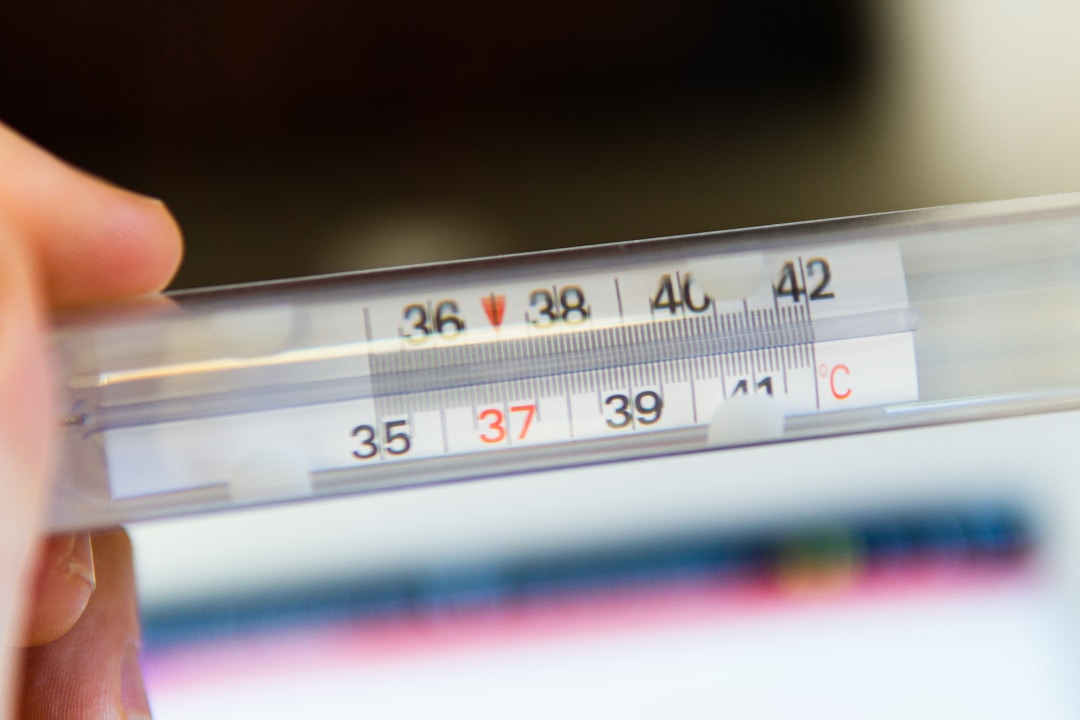
How Pulsyn measures it
We include a skin temperature sensor in the Rune 1 because the signal is too rich to ignore. We do not include it because fertility tracking is a marketable feature. We include it because the finger is a window into the autonomic nervous system, and that window is worth looking through.
The sensor samples frequently, and we store every reading. The raw data is stored in the local database on your phone, encrypted with SQLCipher, using the same 600,000 PBKDF2 iteration key derivation we use for every other data stream. The database table stores a timestamp, the raw sensor value, and a calibrated temperature in degrees C. There is no cloud sync. There is no server-side aggregation. The data never leaves the device unless you explicitly export it or connect the open API.
We do not compute a nightly average. The app shows you the time series. If you want to see your temperature curve from 10 PM to 6 AM, you can. If you want to overlay it with your heart rate and HRV, you can. We do not smooth the data into a trend line because the smoothing choices are subjective. A 10-minute moving average hides stress spikes. A 60-minute moving average hides sleep-onset vasodilation. We leave the filter choice to the user, or to the on-device AI if you enable the premium tier.
The calibration process is simple but specific. We do not ask you to hold your finger in ice water. We calibrate the sensor over your first few nights of normal sleep. The app collects the baseline curve and stores it locally. From night four onward, it computes deviations from that baseline. The baseline is not a single number. It is a 24-hour profile: your typical temperature at 10 PM, 11 PM, midnight, and so on. That profile accounts for your circadian rhythm better than a single nightly average ever could.
The on-device AI runs the analysis locally. It does not send the temperature data to a cloud model. It sees the same raw time series you see, and it looks for patterns: the pre-sleep rise, the post-waking drop, the luteal shift, the sudden dips that might indicate a sympathetic spike. The AI does not make medical claims. It flags deviations from your baseline and explains them in plain text. Your finger temperature dropped sharply at 2:30 AM. Possible causes: cold room, stress spike, or position change. That is the level of honesty we aim for.
We do not compute a cloud baseline. Your baseline is computed on-device, over your own data, and you can reset it. If you move from Phoenix to Minneapolis, your baseline should change. The app lets you mark that transition manually, or it detects the ambient shift automatically after a few nights. The point is that you own the baseline, not our server.
What we do with the raw signal
The sleep detection layer uses skin temperature as a primary input, not a secondary one. The rise in peripheral temperature before sleep is a stronger sleep-onset signal than wrist movement in many people. We combine it with accelerometer data, but the temperature channel carries independent information. If you lie perfectly still reading a book, your accelerometer might think you are asleep. Your skin temperature will know you are not.
The circadian tracking layer uses the daily temperature rhythm to estimate your chronotype. Morning types show an earlier peak in distal temperature. Evening types show a later peak. The app does not label you a lark or owl. It shows you the timing of your peak and lets you compare it to your sleep schedule. If your peak is at 10 PM and you are waking up at 6 AM, the app suggests you might be fighting your biology. That is a much softer claim than a readiness score, and it is more honest.
The stress detection layer looks at acute drops. A sudden 0.5 degree C drop in finger temperature during the day is a classic sympathetic response. It happens before presentations, during arguments, after caffeine. We do not assign a stress score. We show you the event and let you tag it. Over time, the pattern becomes personal and obvious. You do not need a number to tell you that meetings with your manager make your hands cold.
The fertility layer exists, but it is opt-in. We do not assume all users menstruate. If you enable cycle tracking, the app looks for the biphasic shift in the luteal phase. We do not claim clinical accuracy because we have not run a validation study. We claim that the raw data is there, and that you can show it to your clinician. That is a lower bar, but it is an honest one.
The open API lets you export the raw temperature time series as a CSV file. The file contains a timestamp and a temperature reading for every sample. You can load it into Python, R, or Excel. You can run your own analysis. You can show it to a doctor who has never heard of Pulsyn. The data is yours. That is the whole point.
The honest limits
I would be lying if I said the Rune 1 skin temperature sensor is a medical device. It is not. It cannot diagnose fever, hypothermia, or thyroid dysfunction. It cannot replace a basal body thermometer for fertility tracking. The finger is not the mouth, and the sensor is not calibrated to clinical standards.
The thermal lag is real. If you step outside in winter, the sensor will take several minutes to catch up. We try to compensate with algorithmic prediction, but the physics wins. Do not trust the ring for real-time temperature feedback in extreme environments.
The ambient temperature problem is unsolved. We do not have a second sensor to measure room temperature. We ask you to tell us if you changed your sleep environment, but most people will not. The algorithm makes educated guesses, and sometimes it is wrong.
I am not sure if the fertility tracking will be accurate enough to be useful. We are not running a clinical trial. We are giving users access to their own data and letting them decide. That is a different product philosophy from Oura's, and I think it is the right one, but I could be wrong.
About the author
James Hoffmann is the founder of Pulsyn. He has been reading biomedical sensor literature for two years and still thinks the finger is an underrated measurement site.
References
- Szymusiak R. Body temperature and sleep. PubMed.
- Krauchi K, et al. Changes in sleepiness and body temperature precede nocturnal sleep onset: evidence from a polysomnographic study in young men. PubMed.
- Abnormalities in the 24-hour rhythm of skin temperature in cirrhosis: Sleep-wake and general clinical implications. PubMed.
- Effect of a warm footbath before bedtime on body temperature and sleep in older adults with good and poor sleep: an experimental crossover trial. PubMed.